
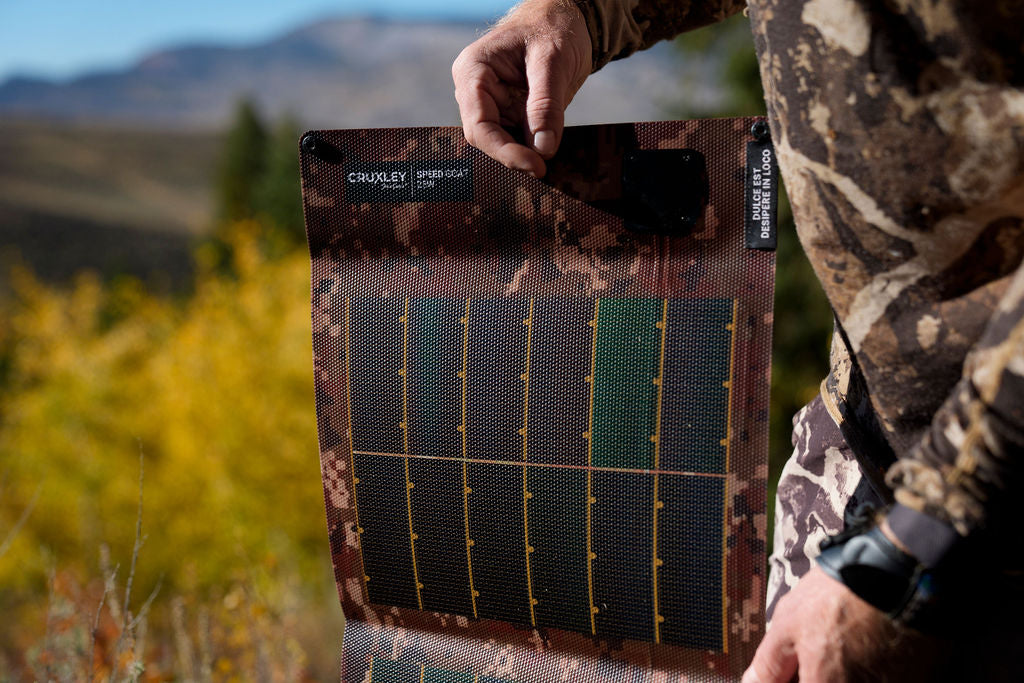
Solar Panels vs Battery Banks
We Love Battery Banks. Here’s why we prefer solar (or both).
Battery banks are great. We carry them. We use them. And if you're heading out for a weekend, they're often the simplest solution. But once trips get longer—or outlets get farther away—we'd rather have a solar panel in our pack. Not because it's more complicated, but because of one indisputable truth: a solar panel is a source and a battery bank is a reserve; the further you get from the nearest power source the more that difference matters.
Plus, battery banks have several shortcomings that can chip away at your peace of mind.
Every Battery Dies
Every battery bank has one thing in common: eventually, it runs out of power. Whether it's after a day, a weekend, or a week, every battery eventually reaches zero.
A solar panel doesn't.
As long as the sun rises, you can keep charging your gear (yes, even in cloudy conditions). You don't have to ration every percentage point or wonder if you packed enough capacity. You simply make more power. That's a very different mindset, the problem shifts from when you’ll run out to when you can charge. One carries some dread, the other some hope.
Battery Banks are Redundant
Every device already has a battery. Most people solve longer trips by carrying more batteries. A second battery bank. A third camera battery.An extra drone battery. It works, until your backpack weighs ten pounds more than it needs to.
A solar panel gives you something batteries never can: the ability to recharge what you already packed. Instead of carrying stored energy, you're carrying the ability to make more.
Battery Banks Have a Bad Habit
Ask enough photographers, hunters, anglers, or backpackers and you'll hear the same story. Somewhere inside a backpack, the power button gets bumped. Hours later, you pull out your battery bank to see it’s unnecessarily depleted. Not because you used it, but because it turned itself on while bumping around in your pack. It's frustrating because you don't notice until you actually need it.
A solar panel doesn't accidentally wake up inside your backpack, you unfold it and start making power.
Field note: if you do buy a battery bank, get one with a hard (or physical) on/off switch. These are much less likely to turn on and drain inside your pack…however backpacks are somehow experts at turning devices on without you realizing it.
Batteries Age. Solar Doesn't…as Quickly
Rechargeable batteries slowly lose capacity. Every charging cycle takes a tiny bite out of their lifespan. Heat accelerates the process. Cold affects performance. Years later, a battery bank that once lasted several days may struggle to make it through one.
Solar panels don't work that way.
Yes, all solar panels gradually lose a small amount of efficiency over many years, quality panels continue producing useful power long after multiple generations of battery banks have been replaced. Take care of them, and they'll keep showing up.
Freedom Changes How You Travel
When you're relying on a battery bank, you're constantly doing math. Can I charge my phone? Should I save power for my GPS? Do I have enough left for my camera tomorrow?
A solar panel changes the equation. Instead of asking how much power you have left, you start asking where you'll have a little sunshine. Instead of solving for scarcity you’re solving for abundance.
That's a much more enjoyable problem to solve.
Again, We’re Fans of Battery Banks.
If this sounds like we're hating on battery banks, we're not. The best outdoor charging system usually includes both. A battery bank stores energy so you can charge your gear after dark or during bad weather. A solar panel replaces the energy you used during the day.
One makes power. The other stores it. They work best together.
Why We Bring Solar Too
If we're heading out for an afternoon, a battery bank is probably all we'll bring.
But if we're disappearing into the mountains for several days, loading up the truck for a road trip, or spending a week living out of a backpack, a solar panel is one of the first things that goes into the pack.